A New Model for Urban Forest Stewardship
The white paper introduces the Ecology Urban Style framework, which moves beyond traditional conservation approaches by integrating social equity and diverse community priorities with ecological management. The framework is built upon four core priorities:
The Interconnected Nature of Community Wellbeing
Community Power, Representation, and Resourcing
Climate Adaptation and Resilience
Wildlife and Biodiversity
“The Cascade Green Zone exists today because of generations of Black leadership in forward-thinking environmental stewardship,” says Corliss Claire, community leader and board member of the Cascade Heights Community Development Corporation. “With this framework, we are operationalizing a model in which saving our urban forest is intertwined with our priorities around economic development, youth engagement, and public health—they grow together. We are showing the nation what it looks like to steward ‘The City in the Forest’ while holistically uplifting the people who live within it.”
Calls to Action
To ensure a healthy future for the urban forest of the Cascade Green Zone, its communities, and biodiversity, the paper offers several concrete recommendations for city and community leaders and their partners, including:
Forest Quantity and Quality: Expanding policy to prioritize the health and quality of the forest in addition to the quantity of trees.
Strategic Ecological Management: Manage forest ecology and health across the network of connected public and private properties.
Monitoring and Evaluation of Community Priorities: Assess community environmental priorities and collaboratively generate solutions that integrate economic development, public health, youth leadership development, and more.
Institutional Partnerships: Expand collaborations with areas universities to increase capacity for addressing community priorities.
Atlanta maintains one of the highest percentages of tree canopy of any major city in the country, and is home to thousands of plant and animal species. The Ecology Urban Style framework offers guidance to advance effective and equitable stewardship of our urban forests, and moves our city forward in its leadership on the national stage for community-centered urban conservation.
Full white paper is available for download at https://cascadeheightsatl.org/publications
###
About the Cascade Heights Community Development Corporation
The Cascade Heights Community Development Corporation is a 501(c)(3) tax exempt organization created by a group of concerned residents living in the Cascade Heights area. The organization’s mission is to make the neighborhood more vibrant and appealing while preserving the distinct character of both the built and natural environment. The activation of a new public realm project, “Cascade Heights Greenspace District: An Eco-recreation Destination,” showcases the mission and vision of preserving and revitalizing historic Cascade Heights as “Atlanta’s Community In A Park.”
Media Contact:
Corina Newsome
215-512-6533
Cascade Heights Community Development Corporation Introduces “Ecology Urban Style” Framework to Protect Atlanta’s Historic Cascade Green Zone
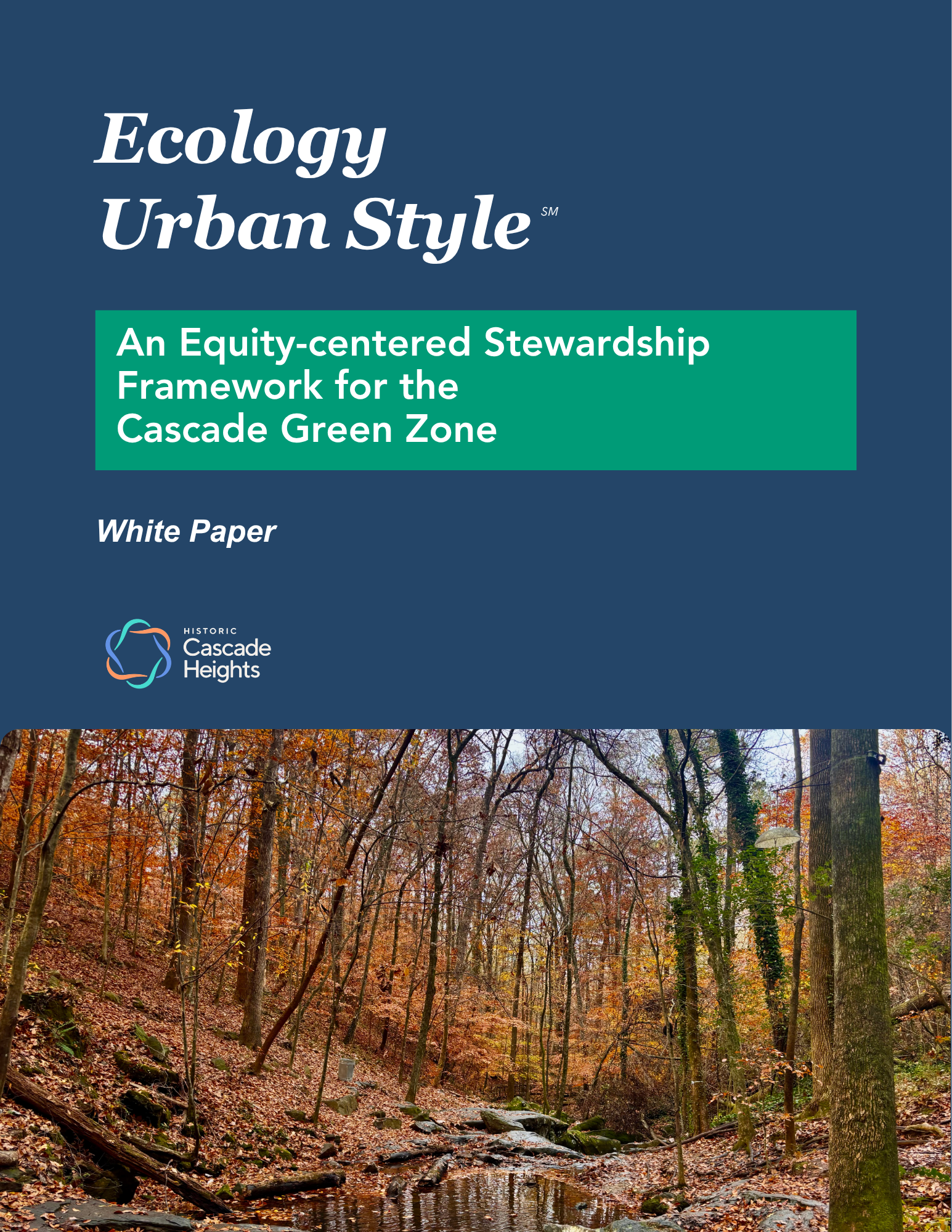
ATLANTA, GA — May 5, 2026 — Following the City of Atlanta’s landmark 2025 designation of the Cascade Heights Greenspace District, a new white paper released today outlines a revolutionary path forward for the area’s 600 acres of forested public green space. Titled “Ecology Urban Style: An Equity-Centered Stewardship Framework for the Cascade Green Zone,” the paper argues that ecological health and community wellbeing are inseparable, offering a blueprint for urban forest management in the 21st century.
For over 50 years, the predominantly Black Cascade Heights community has served as the primary steward of what is now one of the most ecologically significant urban forests in the United States. However, the paper warns that this legacy of stewardship and the critical ecological resource that is the urban forest is under threat from invasive plant species, climate change, and mounting development pressure.